
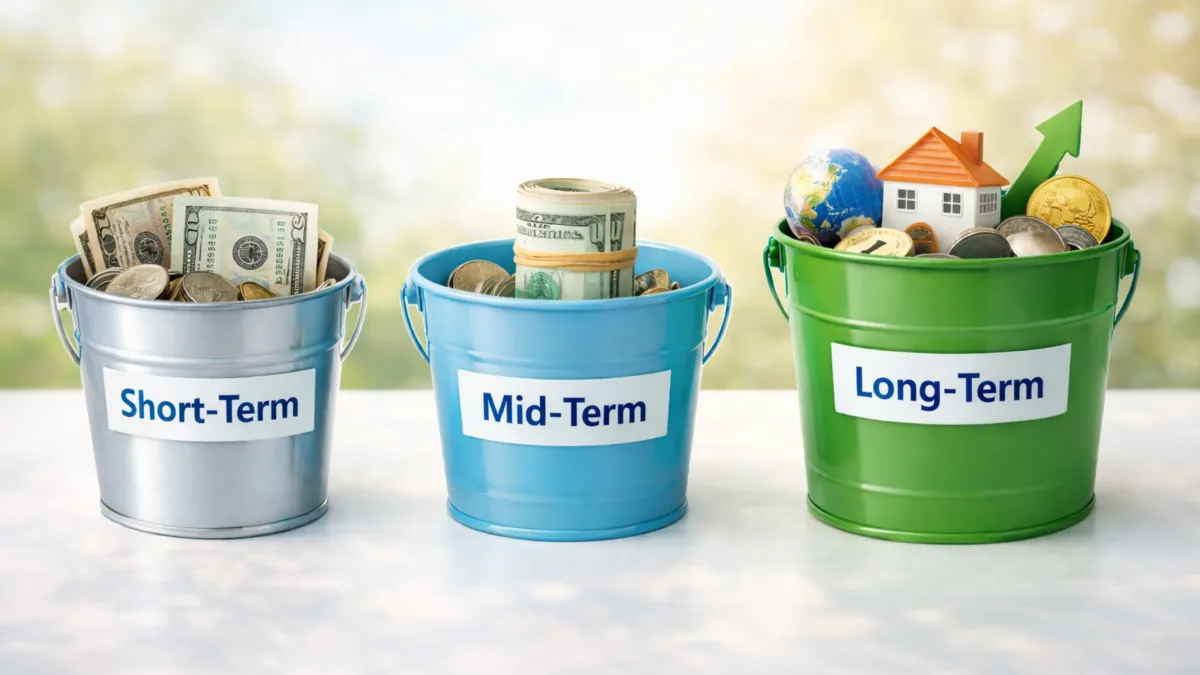
Build a 3-Bucket Retirement Plan in 3 Steps (Short, Mid, Long) | SLD Solutions
Retirement gets stressful when your money is all in one “pile.” You might be fine on paper, but a market dip, a surprise expense, or a few high-cost months can force bad decisions at the worst time.
A 3-bucket retirement plan is a simple way to organize your savings by when you’ll need it. It’s designed to keep cash available for real-life spending, reduce panic during market drops, and still leave room for long-term growth. Here’s how to set it up in a clean, low-stress way.
Step 1: Build the short-term bucket (your “paycheck” money)
Your short-term bucket is for the money you expect to spend first. Think of it as the part of your plan that keeps the lights on while the rest of your portfolio does its job.
A common way to frame this bucket is by time horizon, such as 1–3 years of spending, or in some versions up to 0–5 years, depending on your comfort level and how stable your other income is. The point is the same: this bucket is there so you are not forced to sell long-term investments during a down market just to cover regular expenses. (Source: Charles Schwab)
Once you’ve estimated your monthly spending needs, you can work backward and size this bucket around the portion of expenses that must be paid no matter what, like housing, food, utilities, and insurance. When people say this strategy feels “calmer,” this is why. It gives you a clear runway.
Step 2: Set the mid-term bucket (the refill bucket)
The mid-term bucket is the bridge between “spending now” and “growing for later.” Its job is to refill your short-term bucket over time, without relying on perfect market timing.
One widely used starting range is to keep about one to two years of liquidity needs in the most conservative bucket, then place the next three to five years of living expenses in a moderate-risk “income” bucket, with the rest positioned for longer-term growth. Those time bands are not magic numbers, but they’re a practical way to match risk to timeline. (Source: CAPTRUST)
This bucket is where people often get tripped up because they either take too much risk with money they need soon, or they keep everything too conservative and then worry about inflation. The mid-term bucket is meant to sit in the middle. It’s built for stability plus reasonable growth, so it can do the quiet work of refilling the short-term bucket as the years move forward.
Step 3: Keep the long-term bucket for growth (and set realistic withdrawals)
Your long-term bucket is the money you may not touch for many years. This is the part of the plan that has time to recover after market drops, which is why it can be positioned for growth.
Where people accidentally break their bucket plan is with withdrawals that are too aggressive early on. Recent retirement income research highlighted in early 2026 reporting points to a more conservative “safe starting” withdrawal rate around 3.9% for a 30-year retirement scenario, with the idea that spending is adjusted over time instead of pretending markets are predictable. (Source: Investopedia)
You do not need to obsess over one perfect percentage, but you do want a withdrawal plan that your buckets can actually support. When the long-term bucket has time to work, and withdrawals stay within a realistic range, the whole system feels steadier because each bucket is doing the job it was built for.
Turn the buckets into a plan you can stick with
A bucket plan is only as good as its upkeep. You want a simple rhythm: check spending, review where withdrawals are coming from, and rebalance intentionally so you’re not improvising under pressure. This is also where the “real life” details matter, like how your accounts are coordinated, how risk is managed, and whether your retirement analysis and income gap are truly mapped out.
If you want help turning the 3-bucket idea into a retirement plan tied to your spending and timeline, SLD Solutions can support you with retirement planning and a structured review. You can start by reviewing the Services page and the ‘Our Comprehensive Analysis’ section, which lists Retirement Analysis and Risk Analysis, so you understand what kind of guidance is available before you take the next step. If you would like more retirement topics, you can also browse the SLD Solutions Blog Hub.


